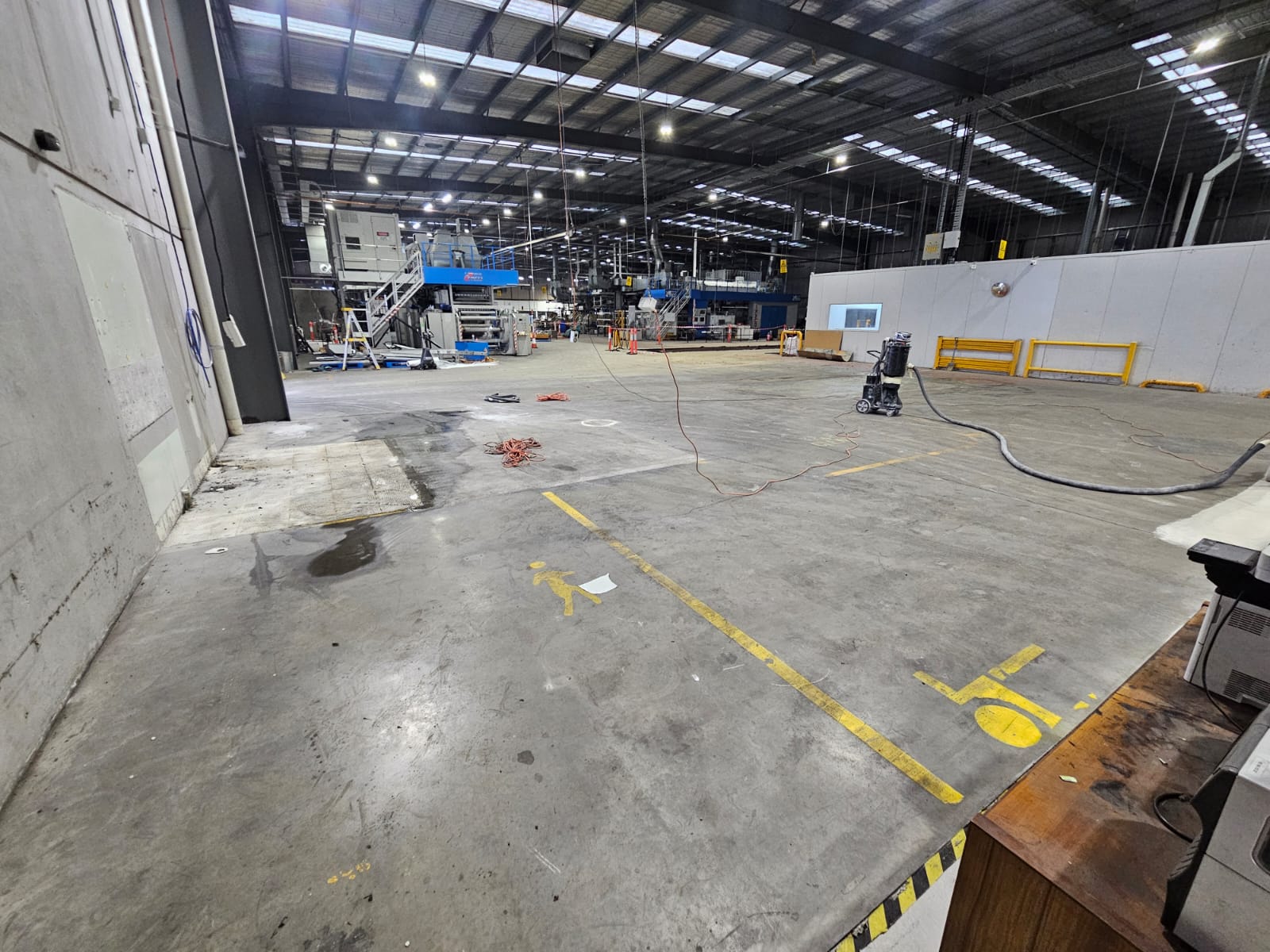
Concrete cracks are one of the most common maintenance issues facing commercial and industrial facilities across Melbourne. They appear in warehouse floors, retail car parks, strata common areas, commercial kitchen floors, factory floors, and loading docks. Most of the time they start small. Most of the time they get ignored. And most of the time, ignoring them costs significantly more than addressing them early.
This guide is for facility managers, property managers, and building owners who want a clear, practical understanding of what concrete cracks mean, what causes them, which ones need immediate attention, and what the repair process actually involves.
Why Concrete Cracks in the First Place
Understanding why concrete cracks is the starting point for making the right repair decision. Not all cracks have the same cause, and not all causes require the same solution.
Shrinkage during curing. Concrete shrinks as it dries and cures after placement. This shrinkage creates internal stress that often results in fine surface cracks, particularly where the concrete pour was large or the curing conditions were not ideal. Shrinkage cracks are typically fine, shallow, and relatively stable once the concrete has fully cured.
Structural movement and settlement. When the ground beneath a concrete slab moves, settles unevenly, or is affected by changes in moisture content, the slab above responds. Settlement cracks tend to be wider, may show vertical displacement at the crack line where one side has moved relative to the other, and are more likely to continue developing over time if the underlying cause is not addressed.
Thermal expansion and contraction. Concrete expands in heat and contracts in cold. In Melbourne’s variable climate, this thermal cycling creates stress that concentrates at weak points in the slab, producing cracks that typically follow consistent patterns and may open and close seasonally.
Overloading beyond design capacity. Heavy point loads from racking systems, machinery, or vehicles exceeding the slab’s design capacity create stress cracks that radiate from the overloaded point. These are common in warehouses and industrial facilities where the original floor design predates current operational demands.
Expansion joint failure. Expansion joints are designed to control where concrete cracks by providing a planned weak point. When expansion joints deteriorate, fill with debris, or were not correctly placed during construction, concrete cracks at unplanned locations instead.
Identifying which of these causes is driving the cracks in your facility is a prerequisite for a repair that lasts. A repair carried out without understanding the root cause will fail again at the same location.
Which Cracks Need Immediate Attention
Not every crack in a concrete floor demands emergency action, but some do. Here is a practical framework for assessing urgency.
Act immediately:
- Any crack with visible vertical displacement where one side is higher than the other, creating a raised edge that presents a trip hazard
- Cracks in areas of heavy forklift or vehicle traffic that are actively widening or developing edge spalling
- Cracks in wet areas, near drainage channels, or anywhere moisture is actively entering the substrate
- Any crack in a food processing, commercial kitchen, or hygiene-critical environment where contamination can accumulate
- Cracks that have caused a coating or epoxy system above them to crack or lift
Monitor and plan:
- Fine, stable hairline cracks in low-traffic areas showing no signs of widening
- Shrinkage cracks in areas with no coating system above them and no moisture exposure
- Cracks in storage areas away from operational zones
The honest reality is that most cracks in the “monitor” category eventually move into the “act” category if left long enough. The cost difference between repairing them early and repairing them late is almost always significant.
The Right Repair Method for Each Type of Crack
Concrete crack repair is not a single process. The right method depends on the crack type, its behaviour, its location, and what the surface will face in service after repair.
Epoxy Injection for Structural Cracks
Epoxy injection fills the crack with a structural epoxy resin under pressure, bonding the two sides of the crack together and restoring load transfer across the joint. This method is appropriate for stable, non-moving cracks where restoring structural continuity is the objective.
Epoxy injection is commonly used for cracks in industrial floor slabs, warehouse floors, and structural concrete elements where the crack has stabilised and the goal is to return the concrete to something approaching its original strength. It is not appropriate for active, moving cracks where ongoing movement will simply re-crack the rigid repair.
Routing and Sealing for Active Cracks
Active cracks, meaning cracks that are still moving due to thermal cycling, ongoing settlement, or other dynamic forces, require a repair that accommodates that movement rather than fighting it. Routing the crack to a consistent width and depth and filling it with a flexible polyurethane or polyurea sealant allows the joint to continue moving without re-cracking.
This method is the correct approach for expansion joint repairs, thermally active cracks in external concrete, and cracks in slabs subject to ongoing minor movement. It does not restore structural continuity but it does seal the crack against moisture and contamination while accommodating the movement that caused it.
Full Depth Repair for Spalled and Structurally Compromised Sections
Where a crack has developed significant edge spalling, where the concrete at the crack edges has broken down, or where the substrate shows signs of structural compromise, a full depth repair is required. This involves removing the damaged concrete back to sound material, preparing the substrate correctly, and placing a repair mortar or concrete that bonds to the existing slab and is finished flush with the surrounding surface.
Full depth repairs are more involved and more expensive than injection or routing and sealing, but they are the only appropriate response where the concrete itself has deteriorated beyond the point where surface treatment will hold.
Crack Stitching for Structural Reinforcement
In situations where a crack has compromised the structural integrity of a slab and simple injection is insufficient, crack stitching provides additional reinforcement. Steel staples or bars are installed perpendicular to the crack line, tying the two sides of the crack together and distributing load across the repair. This method is used in more serious structural situations and is typically combined with epoxy injection of the crack itself.
Concrete Crack Repair for Specific Melbourne Facility Types
Warehouses and Distribution Centres
Warehouse floors in Melbourne’s industrial precincts face some of the most demanding conditions for concrete crack repair. Heavy forklift traffic, point loads from racking, and the constant movement of loaded pallets all concentrate stress at crack locations. Cracks that are acceptable in a low-traffic storage area become genuine operational hazards in active forklift zones.
The priority in warehouse crack repair is restoring a smooth, level surface that equipment can traverse without impact loading at the crack edges. This typically requires a combination of edge grinding to remove spalling, full depth repair where the concrete has broken down, and a surface treatment compatible with the existing floor coating system. Commercial and industrial concrete maintenance and repair services across Melbourne address warehouse crack repair as part of a broader floor maintenance program that keeps facilities operational and compliant.
Strata Car Parks and Common Areas
Strata and body corporate buildings across Melbourne’s inner and middle suburbs consistently deal with concrete cracking in car parks, driveways, pathways, and common area floors. These cracks create both safety risks and ongoing disputes about maintenance responsibility between owners corporations, lot owners, and managing agents.
The repair priority in strata environments is typically trip hazard removal first, followed by crack sealing to prevent moisture ingress into the car park structure, and resurfacing where the extent of cracking warrants a broader treatment. Concrete repairs and maintenance for strata and body corporate properties carried out by a specialist with experience in strata environments navigates the practical and governance challenges that come with working in occupied multi-unit buildings.
Retail Premises and Shopping Centres
Retail environments prioritise appearance alongside safety. A cracked concrete floor in a retail tenancy or shopping centre common area presents both a customer safety risk and a presentation issue that affects the commercial value of the space. Repair methods in retail contexts need to produce a result that is visually consistent with the surrounding surface, not just structurally sound.
Commercial Kitchens and Hospitality Venues
Concrete cracks in commercial kitchen environments carry elevated risk because of the hygiene implications. A crack in a kitchen floor is a location where food residue, oil, and cleaning chemicals accumulate in a way that standard cleaning cannot address. The repair must restore a seamless, hygienic surface that supports the cleaning regime the kitchen operates.
Manufacturing and Industrial Facilities
Manufacturing facilities often have specific requirements for crack repair based on the processes operating in the facility. Chemical resistance, electrostatic discharge properties, load bearing capacity, and surface finish requirements all influence the repair specification. Repairs in manufacturing environments need to be compatible with the operational demands of the facility, not just structurally adequate.
What to Expect From a Professional Concrete Crack Repair Assessment
A professional crack repair assessment for a commercial or industrial facility in Melbourne covers more than a visual inspection of the cracks themselves. It includes:
Root cause identification. Understanding why the cracks have formed determines whether the repair will last. An assessment that jumps straight to repair methods without establishing the cause is an assessment that may produce a repair that fails again.
Crack mapping. Documenting the location, width, length, and character of every crack in the facility gives a complete picture of the current condition and allows repairs to be prioritised and scheduled efficiently.
Moisture assessment. Cracks that are allowing moisture into the substrate need moisture management addressed as part of the repair, not just surface sealing.
Repair specification. A written recommendation covering the appropriate repair method for each crack type, the products to be used, and the expected outcome.
Scheduling. For occupied facilities, repair work needs to be scheduled around operational requirements. Most concrete crack repairs can be completed in sections with minimal disruption to surrounding areas.
Floor Maintenance Solutions provides professional concrete crack repair assessments and repairs for commercial and industrial facilities across Melbourne and Victoria. Our technicians hold the MSF30822 Certificate III in Flooring Technology and bring formal substrate assessment competency to every job.
Contact Floor Maintenance Solutions for a free site assessment at your Melbourne facility. We will assess every crack on your floor, identify the root cause, and give you a clear repair plan that addresses the problem properly the first time.
Find out more about our commercial and industrial concrete maintenance and repair services.