Educational facilities carry a unique responsibility. The people who move through their corridors, classrooms, halls, and outdoor areas every day range from toddlers in childcare to teenagers in secondary schools to adults in universities and TAFEs. They run, they spill things, they move in large groups at speed, and they rely on the adults responsible for their environment to make sure that environment is safe.
The floor is the most consistently used surface in any educational facility — and one of the most consistently overlooked from a safety and maintenance perspective. Worn surfaces, inadequate slip resistance, faded line marking, and deteriorating coatings are common across schools, childcare centres, and tertiary institutions across Victoria. Most of the time, nothing happens. But when it does, the consequences — for a child, a student, a staff member, and the organisation responsible for the facility — are serious.
This is what educational facility managers need to know about flooring safety, compliance obligations, and the practical solutions available.
Why Educational Facilities Have Specific Flooring Obligations
The duty of care that applies to educational facilities goes beyond the general workplace safety obligations that govern industrial and commercial environments. Schools and childcare centres are responsible for the safety of children — a category of person that Australian law and common law treat with a heightened standard of care.
Under the Education and Care Services National Law Act 2010 and the National Quality Framework that governs approved childcare and early education services, providers are required to ensure that every part of the physical environment — including floors — is safe, well-maintained, and free from hazards. This obligation is assessed during regulatory audits and can result in compliance notices, conditions on approval, or in serious cases, suspension of a service’s operating approval.
For primary and secondary schools, the Victorian Department of Education’s Occupational Health and Safety framework places a duty on principals and school councils to identify and manage physical hazards — including floor surface conditions — as part of their ongoing risk management obligations.
For universities and TAFEs, the Work Health and Safety Act 2011 applies in full — treating staff, students, and visitors as persons whose safety must be actively managed, including the condition and performance of floor surfaces throughout the campus.
The common thread across all three sectors is this: a deteriorating, inadequate, or non-compliant floor is not just a maintenance issue. It is a documented safety hazard that creates legal exposure for the organisation responsible for the facility.
The Most Common Flooring Problems in Educational Facilities
Worn and Deteriorating Floor Surfaces
High foot traffic in educational facilities is relentless. Corridors, entries, canteens, sports halls, and common areas absorb thousands of movements every day across a school year. Floor coatings, concrete surfaces, and resilient floor coverings all degrade under this load — losing their protective qualities, their slip resistance, and their structural integrity over time.
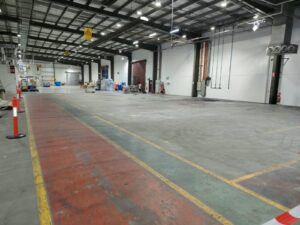
Worn floors in schools and childcare centres don’t just look neglected. They create uneven surfaces that catch feet, produce trip hazards at edges and transitions, and lose the slip resistance properties that protect children and staff in wet or contaminated conditions. Surface deterioration that might be tolerated in a low-risk storage area is a genuine hazard in a primary school corridor where children are moving at pace between classes.
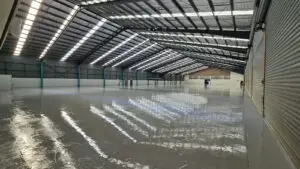
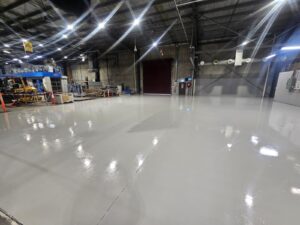
Industrial concrete resurfacing and floor restoration for educational facilities addresses worn and deteriorating surfaces at their root — restoring the substrate to a sound, safe condition rather than applying cosmetic treatments that mask the problem without solving it.
Slip Hazards in High-Risk Areas
Educational facilities contain multiple zones where slip hazard risk is elevated — and where the consequences of a slip incident are particularly serious given the age and vulnerability of the people using the space.
Wet areas in childcare centres — bathrooms, nappy change areas, outdoor play areas with water features — require floor surfaces that maintain adequate slip resistance under continuous wet conditions. AS/NZS 4586 slip resistance requirements for childcare and early education environments set specific minimum ratings for wet areas that many older facilities do not currently meet.
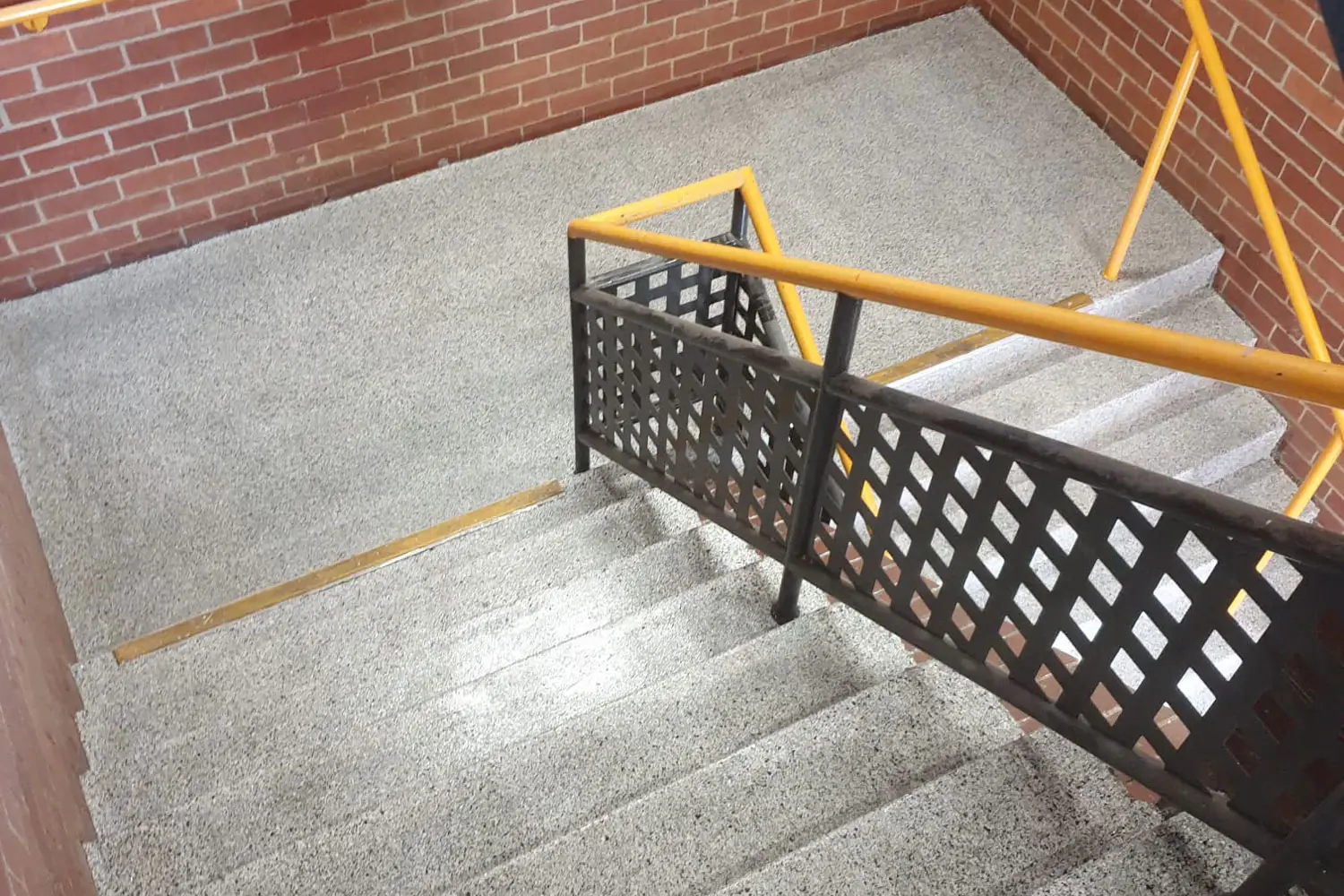
In schools, canteen areas, bathroom blocks, outdoor covered walkways, and sports change rooms all present wet surface conditions during normal use. Without adequate anti-slip floor coatings for school and educational facility wet areas, these zones remain persistent slip hazard points regardless of how well they are cleaned and maintained.
University and TAFE campuses add further complexity — with food courts, laboratories, workshops, and large outdoor areas all presenting different slip hazard profiles that require zone-specific assessment and treatment.
Faded and Inadequate Line Marking
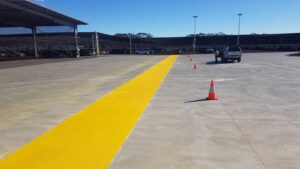
Line marking in educational facilities serves a safety function that is often underestimated until it fails. In primary school playgrounds, clearly marked zones define where different activities occur and help manage the movement of large numbers of children in a confined space. In secondary school and university car parks, pedestrian crossings, access roads, and parking bays need to be clearly and consistently marked to manage the interaction between students, staff, and vehicles.
In childcare centres, defined activity zones, pathway markings, and boundary indicators are part of the physical environment that supports supervision and risk management — requirements that sit directly within the National Quality Framework assessment criteria.
Faded, inconsistent, or absent line marking in educational environments is more than a compliance gap. It removes a layer of visual structure that the people using the space — particularly younger children — rely on to understand where they are and where they should be.
Professional line marking and safety zoning for schools and educational facilities restores that visual structure with durable, high-visibility markings specified for the specific demands of each zone — from playground activity areas to car park pedestrian crossings to indoor corridor flow markings.
Trip Hazards From Surface Transitions and Damage
Cracked concrete paths, raised expansion joints, damaged threshold strips, and uneven surface transitions between flooring types are consistent sources of trip hazard risk in educational facilities — particularly for younger children who are less able to anticipate and navigate irregular surfaces.
Trip hazard removal and concrete repair for schools and childcare centres addresses these specific hazards directly — grinding raised edges, repairing cracked and broken surfaces, and restoring smooth, safe transitions between areas. It is one of the most cost-effective safety interventions available for older educational facilities where surface deterioration has accumulated over years of deferred maintenance.
What a Flooring Safety Assessment Looks Like for an Educational Facility
A proper flooring safety assessment for a school, childcare centre, or university campus goes beyond a visual walkthrough. It evaluates each zone of the facility against the specific risk profile and compliance requirements that apply to that area — considering the type of users, the surface conditions, the likely contamination in that zone, and the relevant Australian standards that govern performance.
For a childcare centre, this typically covers:
- Wet area slip resistance testing against AS/NZS 4586 minimum ratings
- Condition assessment of outdoor play area surfaces
- Identification of trip hazards at transitions and path edges
- Review of line marking against National Quality Framework requirements
For a school, the assessment covers:
- Corridor and canteen floor surface condition and slip resistance
- Outdoor covered walkway and bathroom block slip hazard risk
- Playground line marking condition and coverage
- Car park line marking for pedestrian and vehicle separation
- Any areas of surface deterioration presenting trip hazard risk
For a university or TAFE campus, the scope expands further — encompassing workshop and laboratory floor surfaces, large common area floors, car parks, and outdoor pedestrian areas across what is often a multi-building, high-traffic environment.
Planning Flooring Work Around the School Calendar
One of the most practical considerations for educational facility managers is timing. Flooring work — whether resurfacing, anti-slip coating, line marking, or trip hazard repair — needs to be planned around periods when the facility is not in full operation.
The Victorian school holiday periods provide natural windows for flooring work that would otherwise disrupt the school day or require extended area closures. For childcare centres that operate across standard holiday periods, careful zone-by-zone scheduling allows work to proceed without requiring full facility closure.
Floor Maintenance Solutions works with educational facilities across Melbourne and Victoria to plan and schedule flooring projects around operational requirements — completing work during holiday periods, weekends, or staged area closures that minimise disruption to students, staff, and families.
The Cost of Deferring Flooring Maintenance in Educational Facilities
Flooring maintenance in educational facilities is frequently deferred — often because budgets are constrained and floors that are functional, if deteriorating, don’t feel like an immediate priority compared to other facility needs.
The problem with deferral is that floor deterioration is progressive. A surface that needs resurfacing today will need full replacement in two years. A trip hazard that could be ground down for a few hundred dollars today becomes a workers’ compensation claim or a parent complaint next term. A slip resistance rating that’s marginally below standard today becomes a significant compliance gap after the next wet season.
The facilities that manage flooring costs most effectively are those that treat floor maintenance as a scheduled, budgeted item — not a reactive expense triggered by incidents or audit findings. A planned approach to floor maintenance across a school or childcare facility consistently costs less over a five-year horizon than the combination of emergency repairs, incident costs, and deferred replacement that results from doing nothing until something fails.
Working With a Certified Flooring Specialist
Floor Maintenance Solutions holds the MSF30822 Certificate III in Flooring Technology — Australia’s nationally recognised trade qualification for resin and flooring specialists. Our technicians are trained to assess substrates, specify appropriate systems, and install flooring solutions that meet Australian standards across a wide range of facility types — including educational environments with specific compliance requirements.
We work with schools, childcare centres, universities, and TAFEs across Melbourne and Victoria — providing flooring assessments, scheduled maintenance programs, and targeted remediation work that keeps educational facilities safe, compliant, and functional for the people who use them every day.
Contact Floor Maintenance Solutions for a free site assessment of your educational facility. We’ll identify the flooring hazards present, confirm what compliance obligations apply to your specific environment, and provide a clear, practical plan for addressing them — on a schedule that works around your operations.